Change management is something most companies struggle with. And honestly, the numbers back that up - somewhere between 60 and 70% of change initiatives fail outright. The rest? A mix of partial wins and hard-to-measure outcomes.
The reason usually isn't the change itself. It's the communication around it. Getting employees to accept a change, actually adopt it, and then keep doing it long after the announcement email is forgotten - that takes real communication work. Here are a few strategies and best practices that can help.
What is Change Management?
Before building a communication strategy, it helps to get clear on what change management actually is.
Change management is a structured approach to moving an organization and its employees through a transition. It covers planning, executing, and tracking initiatives - whether you're rolling out new technology, restructuring teams, reorganizing processes, or shifting company values.
At its core, change management recognizes that businesses are made of people. And people play the deciding role in whether a change sticks or falls apart. As Jim Heininger put it at PRSA Connect: "Organizations don't change. People do."
That means proper change management has to deal with the human side - resistance, confusion, fear of the unknown, and the very real concern that a new system or process might make someone's job harder (or make it disappear).
The AI Factor in 2026
This year, the human side of change management is more complicated than ever. According to a Gartner survey of 110 CHROs from December 2025, 78% agree that workflows and roles will need to change to get the most out of their AI investments. Just over half of organizations have already redesigned or redefined roles because of AI.
AI isn't just another technology rollout. It's creating what Gartner calls "catalytic change" - rapid, high-stakes shifts that ripple across entire organizations. And it's happening unevenly. Some teams are adapting fast while others are struggling to keep up, which creates friction and frustration.
For internal comms teams, this means change communication can't follow the old playbook of one announcement and a few follow-ups. The pace and complexity of AI-driven change demands something more adaptive.
Key Components of Change Management
To manage change well, a few things need to be in place:
A clear vision and goals.
Change initiatives need well-defined objectives that spell out desired outcomes. Without direction, employees are left guessing about the purpose and benefits of the change.
Effective communication.
This is the backbone. A solid communication strategy keeps employees informed, addresses concerns, and provides regular updates throughout the process. Research from a July 2025 Gartner survey of 313 senior-level respondents found that organizations which continuously adapt their change plans based on employee responses are four times more likely to achieve change success.
Training and support systems.
Change often demands new skills. Equipping employees with training and ongoing support gives them the ability to actually make the transition. In the AI era, this also means helping people learn to work alongside new tools rather than just handing them a login.
Measurement.
Feedback mechanisms let you assess whether your efforts are working. Monitoring progress, evaluating outcomes, and collecting employee input regularly provides the data you need to adjust your strategy. Only 43% of employees believe their organization manages change effectively, down from 60% in 2019 - so clearly, most organizations have room to improve here.
Benefits of Change Management
Change management is a lot of work. But the payoff is real:
Lower resistance.
Addressing concerns early and building trust through open communication reduces pushback. At 41%, organizational mistrust is the number one driver of employee resistance to change, followed by lack of awareness around the reason for the change at 39%.
Increased engagement.
When employees are involved in the change process, they feel ownership over the outcome. Engaging in two-way conversation throughout the process increases change success by 32%, according to recent research.
Sustained results.
When employees understand the change, its purpose, and what it means for them personally, adoption rates go up and results last longer. When employees own their implementation planning, change success increases by 24%.
Enhanced agility.
Companies with strong change management practices can respond faster to market shifts and new opportunities. In a world where 79.7% of organizations need to revamp strategies every two to five years, agility isn't optional - it's survival.
What is Change Management Communication?
Change management communication - sometimes just called "change communication" - covers all the ways you share messages and guide your organization through a transition. Good communication explains why a change is happening and clearly spells out how it will affect different groups of employees.
But here's the thing most people get wrong: communicating change isn't a one-time event. You don't send an all-hands email, check the box, and move on. To get changes to stick, you need a communication plan that keeps reinforcing the message over time.
The Prosci Methodology recommends communicating key messages five to seven times to be effective, using multiple channels - emails, meetings, forums, and digital tools.
The Purpose of Change Management Communication
Share the why. Employees need to understand the reasons behind a change. Why this, why now, and what's at risk if the organization doesn't change? When people grasp the rationale, it creates a sense of purpose and helps align their effort with broader goals.
Address concerns and resistance. Change creates uncertainty. Nearly 38% of employees say they fear the unknown during organizational transitions, and only 38% are currently willing to support organizational change - down from 74% in 2016. That's a steep decline, and it signals that organizations are wearing people out with poorly communicated changes.
Involve employees. Change communication should be a two-way conversation, not a broadcast. Town halls, focus groups, workshops, and digital platforms where employees can share their thoughts and contribute to decisions make a real difference. When employees are involved in decision-making, change success increases by 15%.
Sustain momentum and reinforce changes. Communication doesn't end at launch. Ongoing updates, progress reports, and celebrating milestones keep the change top of mind. Without reinforcement, even well-received changes fade.
Change Fatigue Is Real - and Getting Worse

So what does that mean in practice? You can't just pile on more change communications. Every message needs to earn its place. Be deliberate about what you communicate, when, and to whom.
Elements of an Effective Change Management Communication Plan
A strong plan needs:
- Clear and consistent messaging on a deliberate cadence
- A targeted approach - different employee groups need different messages
- Multiple channels to share and reinforce key points
- Feedback mechanisms to collect real-time input on how the plan is landing
- Training materials for each phase of the change
- Manager materials so they can reinforce the change with their teams (managers influence 70% of employee engagement, according to Gallup's 2025 State of the Global Workplace Report)
Change Management Communication Strategy
Several frameworks can guide your communication planning. Here are three worth knowing:
The Prosci ADKAR Model

The ADKAR model is useful because it breaks communication needs into stages. And it includes a reinforcement phase that many other models skip - which matters, since that's where most changes fall apart.
Awareness: Initial communications to let people know a change is coming.
Desire: Sharing why the change matters and how it benefits employees personally. This is where you answer the "What's in it for me?" question.
Knowledge: Teaching teams what they need to know to change successfully.
Ability: Actually helping employees practice and perform the desired behavior.
Reinforcement: Ongoing communication to remind employees of the change and what's expected. This phase may continue indefinitely for complex changes.
Technology Adoption Curve
This model is especially relevant right now, given how many organizations are rolling out AI tools. People adopt new technology at different speeds:
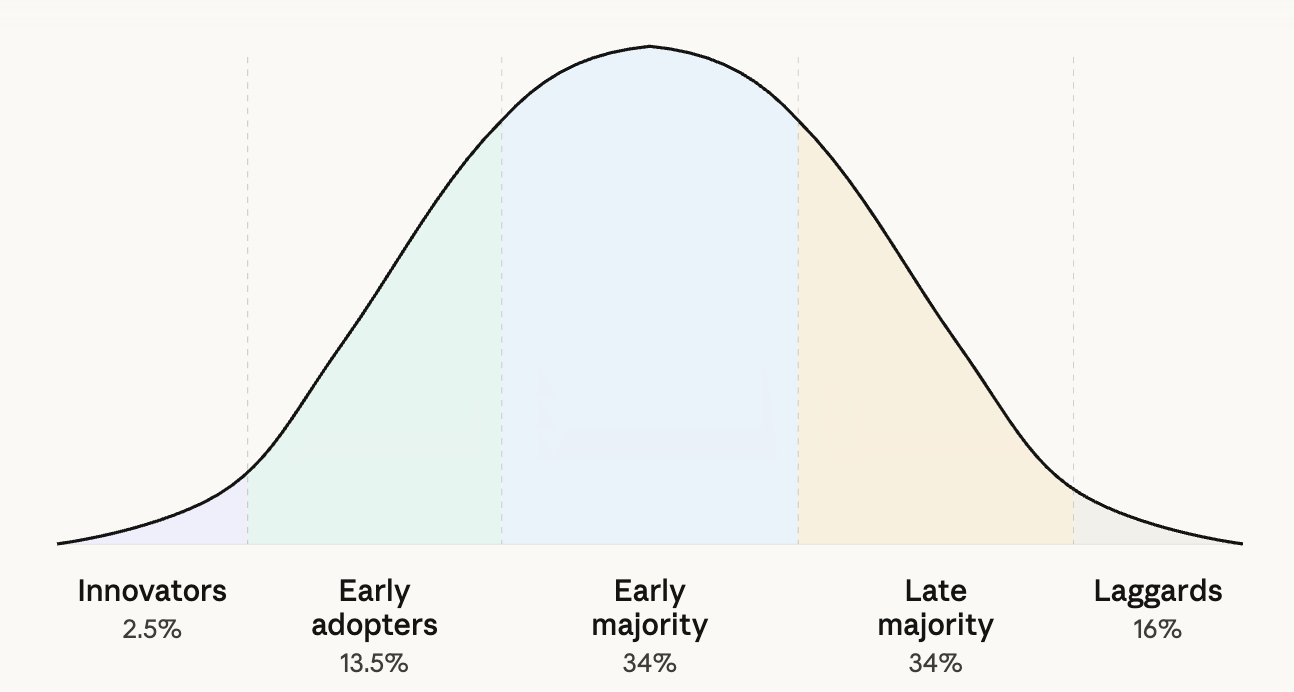
Innovators: Your champions. They want what's new because they like being first. Find these people and tap them to build early momentum.
Early Adopters: Highly engaged people who aren't deeply resistant to change. They'll try new tools that solve problems, even if it means disrupting existing workflows.
Early Majority: More engaged employees who need a bit of convincing. Answer the "What's in it for me?" question and they'll get on board.
Late Majority: They want proof. They need to see the first half of the company use a new tool successfully before they'll commit. Sometimes they just need to be told: "This is mandatory."
In the AI era, the gap between innovators and the late majority can be wider than ever. Only 54% of employees used AI over the past year, according to PwC. Daily AI users report higher productivity and job security - but that benefit isn't reaching everyone equally, which creates real inequities.
Change Agility Methodology
This method focuses on building organizational agility through a thoughtful approach:
Purpose.
Define why you're changing. Different groups in your company might have different reasons, and that's fine - but each group needs a "why" that makes sense to them.
Design.
Bring a cross-section of employees together to work on the change program. Don't design it in a conference room and push it down.
Pilot.
This step gets skipped too often. A pilot lets you test whether a change is right for your company and work out problems in messaging and support before going wide. Be prepared to discover that a change is a bad idea during the pilot. Better to learn that with 50 people than 5,000. Organizations that pilot changes before broad deployment increase their success rate threefold.
Deploy. Deployment isn't just flipping a switch. This phase means continuing to collect feedback, monitor progress, and acknowledge wins.
Change Management Best Practices
Regardless of which framework you use, a few things consistently make the difference:
Create feedback loops.
People are less resistant to change when they feel involved. If you consult focus groups and leaders across the organization before pushing changes from the top, you're more likely to win buy-in. Bonus: they might spot flaws in your plan early, saving time and money. Open communication reduces employee anger during transitions from 24% to 5%.
Define the type of change.
Is it core, transitional, or transformational? Who is actually being affected? What barriers exist? These questions shape your entire strategy. 29% of employees in one UK survey said their company didn't clearly communicate the reason for a change - a basic failure that's easy to avoid.
Develop personas for impact analysis.
Interview your major stakeholder groups. Understand their needs and how the change will affect them. Then use those insights to craft targeted messaging. Not everyone needs the same level of detail or support.
Measure and keep checking in.
Continuous measurement matters, even if you did thorough research upfront. 81% of effective change management projects stay on budget when they include regular monitoring and course correction.
Handle AI change like a trust project, not a tech project.
Employees worry that AI sentiment analysis is surveillance. They fear their messages are being monitored. When rolling out AI tools, be direct about what data is collected, how it's used, and what employees can expect. Gartner recommends using adoption data to understand where employees need support, and pairing those insights with efforts to strengthen psychological safety.
Use employee involvement strategically.
With so much change happening at once, Gartner's 2026 guidance is to use direct employee involvement sparingly - engage them directly only for major strategic shifts or when a change would likely fail without their input. For everything else, frame the change as a journey and focus on helping employees make progress, rather than demanding they buy in to a final vision all at once.
Creating a Holistic Change Management Strategy
Beyond individual campaigns, it's worth stepping back and looking at change from a higher level.
How much change is happening across your organization right now? Is the volume overwhelming your teams? Are you changing systems too frequently rather than taking the time to pick the right solutions?
What's the general attitude toward change at your company? Are people focused on solving real problems, or do changes feel arbitrary? 96% of organizations are undergoing some form of transformation - but not all of that change is well-considered.
As a communications team, you have the ability - and the responsibility - to flag when too much change is happening at once. Sometimes being a strategic advisor means being the person who says, "We're asking too much of our field teams right now." Properly pacing change and shifting the collective mindset around it can be the difference between changes that stick and changes that breed cynicism.
In 2026, that also means paying attention to how AI is reshaping work at different speeds across your organization. Some teams are running ahead. Others feel left behind. Your communication plan needs to account for both groups - not with one-size-fits-all messaging, but with targeted, honest communication that meets people where they are.
None of this is easy. But the companies that take communication seriously during change - rather than treating it as an afterthought - tend to come out the other side with employees who trust leadership enough to do it again next time. And in 2026, "next time" is probably next quarter.


















Recent articles




Operate. Connect. Perform.
EngagedlyFX delivers actionable insights and engagement tools to reduce turnover, increase productivity and improve employee well-being.