Employee communication and engagement platforms have become vital in today’s rapidly evolving workplace. As companies shift to hybrid and frontline-first models, the need for tools that foster collaboration, share knowledge, and boost engagement has never been greater. These platforms bring together features like internal communication, task management, employee engagement, and knowledge sharing into a single hub that aligns people with organizational goals.
MangoApps has long been a strong player in this space, offering an intranet and employee experience platform that centralizes communication and collaboration. However, every organization has unique needs, and some may find MangoApps does not perfectly fit their requirements. Whether it’s due to pricing, scalability, integration needs, or the desire for more specialized engagement features, many companies look to alternatives that better align with their workforce and culture.
This article explores the top MangoApps alternatives in 2026, giving a detailed look at each platform’s strengths, user experience, and unique selling points (USPs). Our goal is to help organizations make informed decisions when selecting the right communication and engagement tool for their teams.
Criteria for Evaluation
Features
The best employee communication and engagement platforms offer:
- Internal communication tools for announcements, chat, and targeted messaging
- Employee engagement surveys and feedback channels
- Knowledge sharing and intranet functionality
- Task and shift management capabilities for frontline teams
- Analytics and reporting to track impact and adoption
- Seamless integrations with HR and productivity systems
User Experience
Adoption depends on how intuitive the platform is:
- Clean, user-friendly design
- Mobile-first accessibility for frontline workers
- Customization to reflect company culture and workflows
- Ongoing support, training, and customer success resources
Unique Selling Points (USPs)
Each platform stands out in its own way, whether through:
- A mobile-first approach designed for deskless employees
- Deep analytics and reporting capabilities
- Strong integrations with HR and collaboration tools
- Custom intranet branding and personalization
- Recognition and engagement features that foster culture
By applying these criteria, this article identifies the 10 strongest MangoApps alternatives organizations should evaluate in 2026.
Top 10 MangoApps Alternatives You Need to Know in 2026
1. EngagedlyFX

EngagedlyFX is a frontline workforce platform built to turn day-to-day frontline signals into clear, actionable decisions.
It connects Operate, Connect, and Perform into one intelligent platform powered by AI and automation, where work is structured through workflows that run every shift. From onboarding and training to task execution, communication, performance, and compliance, everything is connected and guided without manual coordination.
What sets EngagedlyFX apart is how AI works across the system. It continuously analyzes signals from operations, workforce activity, and performance to identify what needs attention, surface risks early, and recommend the next best actions. Instead of managers interpreting dashboards, the system highlights priorities, triggers workflows, and drives follow-through.
The result is a more controlled, responsive frontline where teams act faster, managers spend less time coordinating, and productivity, safety, and retention improve at scale.
Best For: Healthcare, manufacturing, and distributed frontline teams that need execution, not just communication
Key Features:
- Connect: Chat, Employee Voice, News Feed, Onboarding, Push Notifications
- Operate: Task management, Shift Scheduling, Workflows, and Incident Reporting, On-site Training
- Perform: Goals, Lifecycle Feedback, Recognition, and Performance Reviews
- Intelligence: AI-powered insights to surface risks, Manager Coach, Workflows, and Inbox
Limitations:
- Broader platform compared to lightweight messaging tools
- Requires structured rollout to unlock full value
2. Staffbase
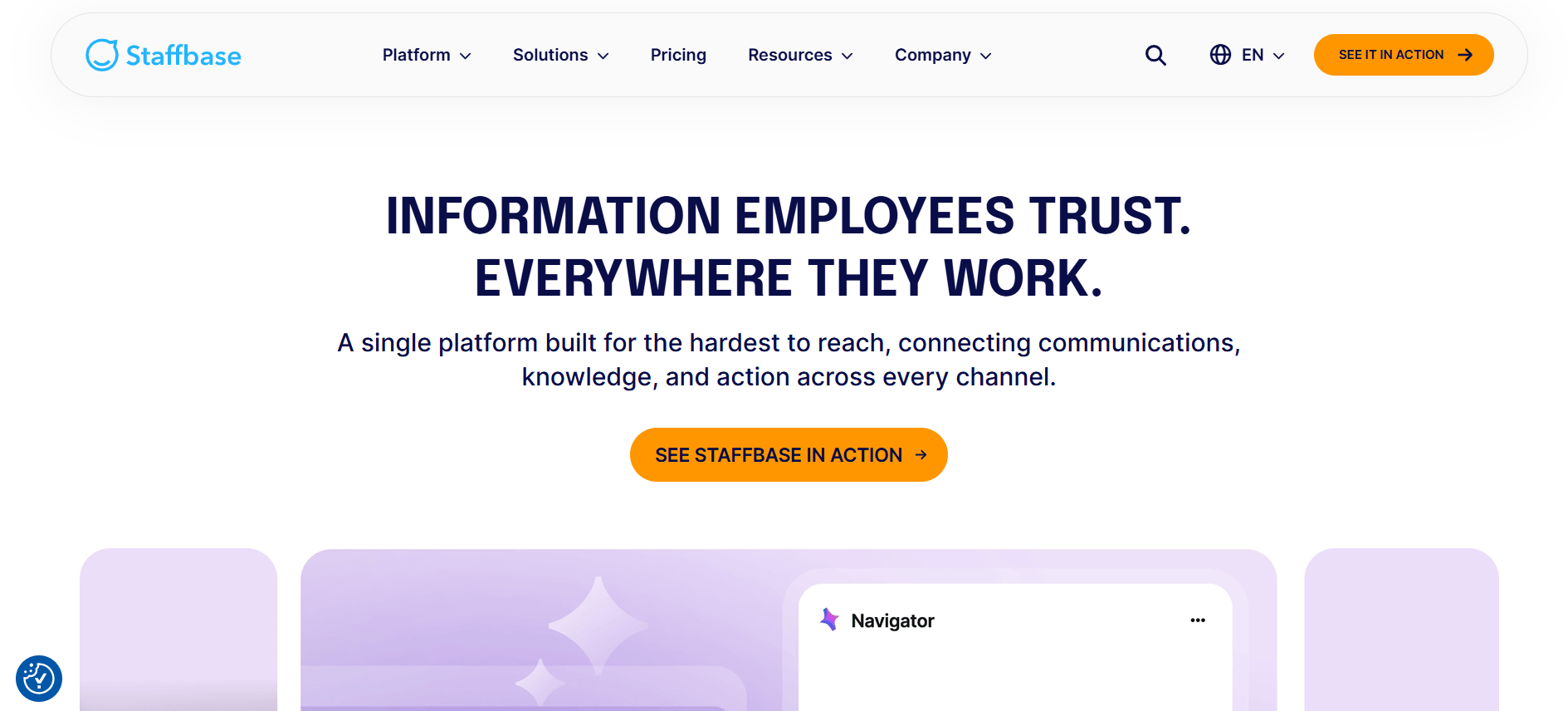
What it is: An enterprise internal communications platform that reaches employees through a branded mobile app, intranet, email newsletters, and digital signage. Built for structured, top-down publishing — editorial workflows, multilingual support, audience segmentation, tight Microsoft 365 integration.
Best for: Large, global organizations (typically 1,000+ employees) with dispersed workforces that need branded, consistent messaging across multiple channels.
Key features:
- Branded employee app
- Intranet
- Email newsletter tool
- Digital signage
- Content scheduling and targeting
- Audience segmentation
- Multilingual support
- Engagement surveys and analytics
- Push notifications
- Microsoft 365 integration
- Editorial planning suite
Limitations:
- Heavily top-down. If you want employees posting back, there are better options
- Configuration gets complicated for smaller teams
- Priced for enterprise — mid-sized orgs often find it doesn't pencil out
- Not much for frontline operational workflows
Pricing: Custom, quote-based. Not published.
3. Workvivo
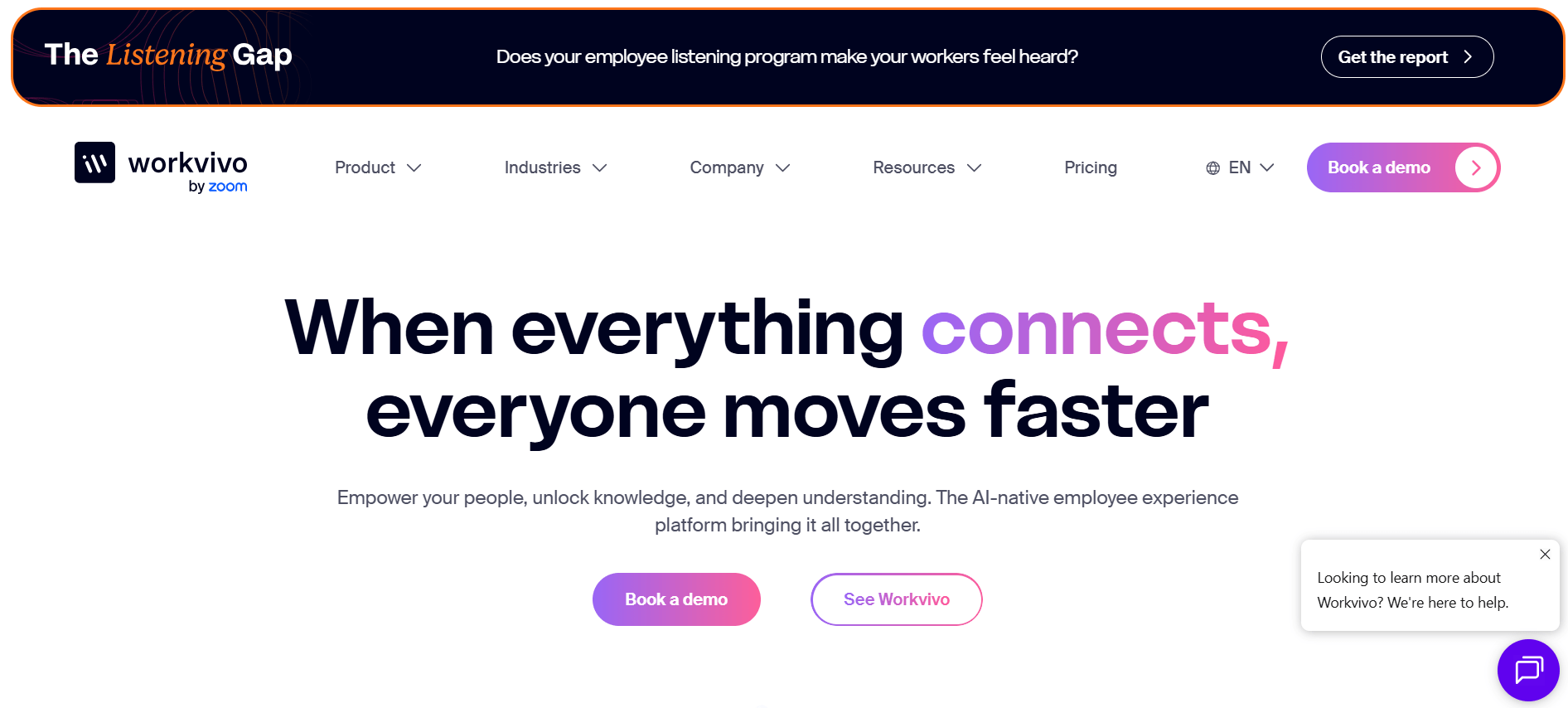
What it is: Workvivo (acquired by Zoom in April 2023) is an employee experience platform that looks and feels like a social network. Employees post, react, recognize peers, watch leadership updates — all in a familiar feed-based interface. Integrates with 40+ business tools and leans hard into culture and community.
Best for: Mid-to-large enterprises where employee culture and adoption matter more than deep intranet customization.
Key features:
- Social activity feed
- Employee recognition (shout-outs)
- Polls and surveys
- Live streaming
- Company news and announcements
- Leadership posts
- Document access
- Integrations with enterprise tools (including Zoom)
- Mobile app for iOS and Android
Limitations:
- Analytics are lighter than some competitors
- Not a lot of operational or task management
- Pricing starts at 250 users minimum, which locks out smaller orgs entirely
- Business plan starts at around $20,000/year per multiple third-party sources
Pricing: Quote-based. Third-party sources consistently cite the Business plan starting around $20,000/year, with Enterprise pricing negotiated on top. Contact sales for specifics.
4. FirstUp
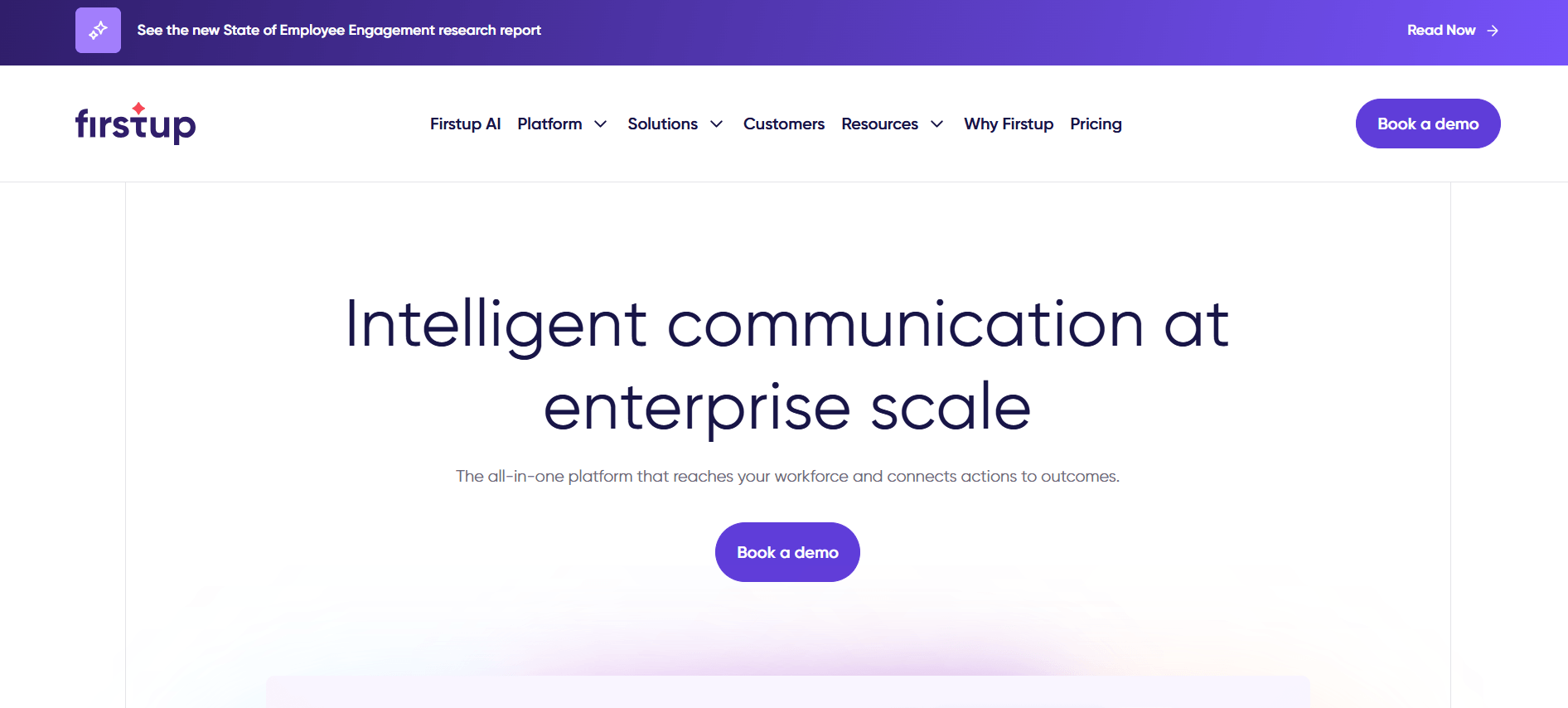
What it is: An employee communications platform for big enterprises with distributed workforces. Focus is automated, personalized content delivery across channels. Dynamic Signal and SocialChorus merged in 2021 to form FirstUp.
Best for: Large enterprises with mature internal comms teams that want AI-driven personalization and multi-channel campaign orchestration backed by real analytics.
Key features:
- AI-powered personalized content delivery
- Multi-channel communication (email, mobile app, SMS, digital signage)
- Campaign planning and scheduling
- Audience segmentation
- Engagement analytics
- HRIS and enterprise integrations
- Governance controls
Limitations:
- Expensive — not for teams with a small comms budget
- Not an intranet or operational platform
- Communications-focused, so don't expect task or workflow management
- Admin can be complex
Pricing: Custom, enterprise pricing.
5. Beekeeper.io (Now LumApps)
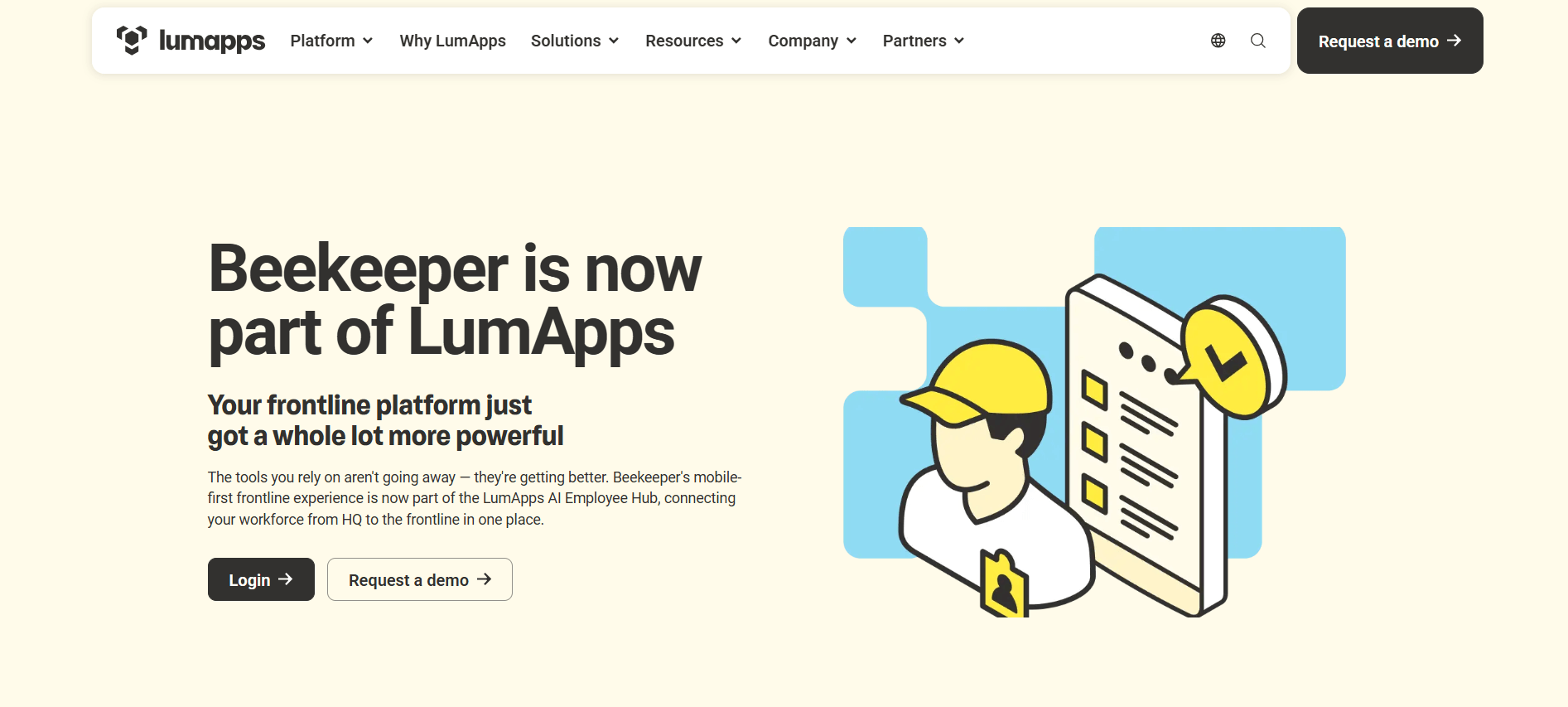
What it is: A mobile-first communication platform built for deskless workers. No corporate email required, which matters when half your workforce doesn't have a company laptop. Used by 1,200+ companies.
Best for: Shift-based and frontline industries — manufacturing, hospitality, retail, and construction are the primary targets. Customers include Caribou Coffee, Royal Farms, Life Time, and Cargill.
Key features:
- Secure team messaging, group chats, and voice messaging
- Company announcements via "streams" (targeted news feeds)
- Operational checklists, forms, and task automation
- Shift management
- Document sharing
- Surveys and polls
- HR document access
- Push notifications
- Inline translation supporting 200+ languages
- AI-powered sentiment analysis and frontline intelligence
- Mobile-first (no corporate email required)
- Integrations with HRIS, LMS, and payroll systems
Limitations:
- Less suited for knowledge-based collaboration or enterprise-scale analytics
- Strategic comms and culture-building tools are lighter than Workvivo or Staffbase
- Desktop version has fewer features than mobile — some reviewers flag this
- Custom pricing, nothing published
- Per-user pricing model can get expensive in high-turnover industries
Pricing: Custom, quote-based.
6. Connecteam
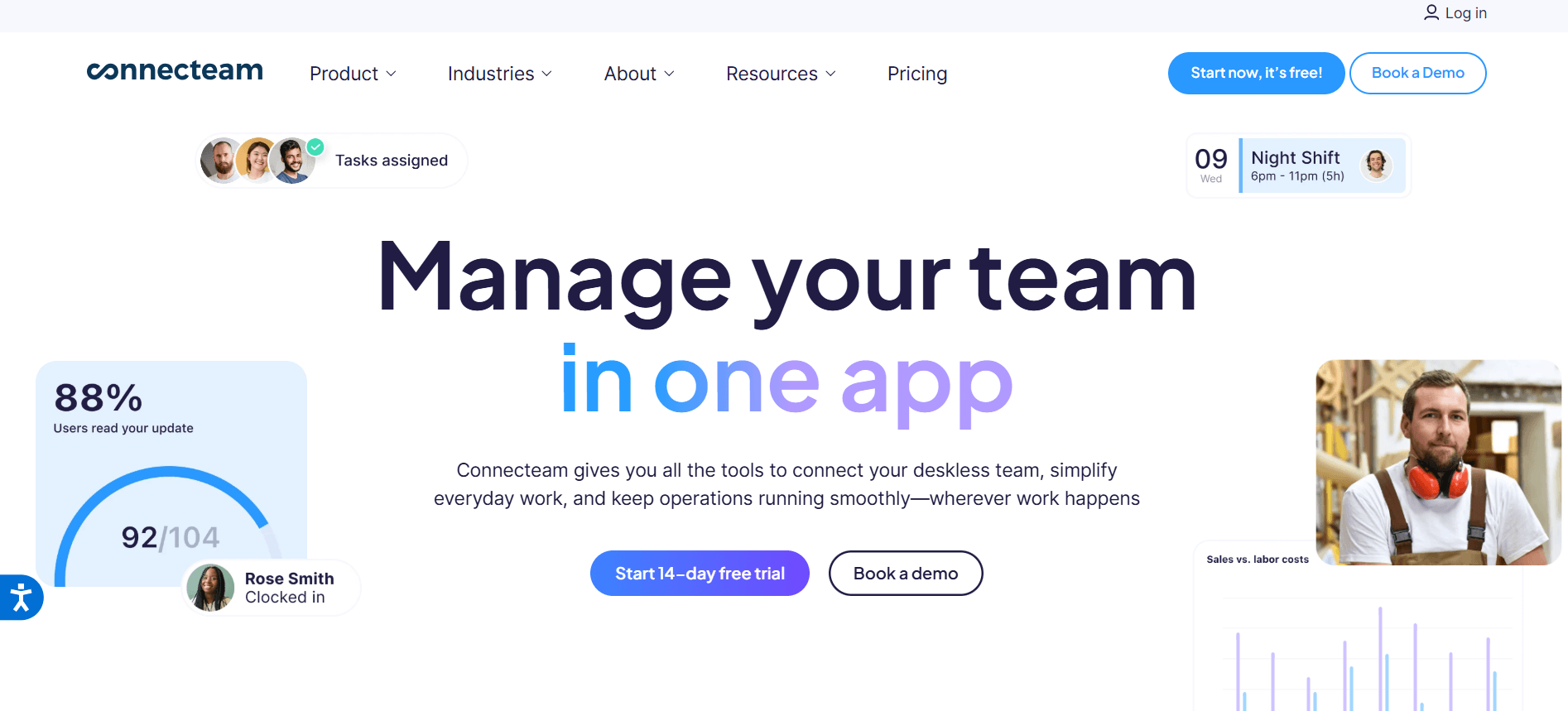
What it is: An all-in-one workforce management platform that goes beyond communication into scheduling, time tracking, task management, training, and a knowledge base — all in one mobile app. Probably the most feature-dense tool in this category at its price point.
Best for: Small to mid-sized businesses with deskless or field teams that want to consolidate communication, operations, and HR into a single tool.
Key features:
- Team chat and updates feed
- Task management
- Shift scheduling
- Time tracking with GPS and geofencing
- Digital forms and checklists
- Onboarding and training tools
- Knowledge base
- Recognition and surveys
- Push notifications
- Integrations with QuickBooks, Gusto, and payroll systems
Limitations:
- Intranet and knowledge management are shallow compared to enterprise platforms
- The hub-based pricing structure (Operations, Communications, HR & Skills are priced separately) confuses first-time buyers
- Communication features are more basic than dedicated tools like Staffbase or Workvivo
- HIPAA-registered accounts incur additional fees — worth knowing if you're in healthcare
- Limited customization
Pricing: Free Small Business Plan for up to 10 users. Beyond that, Connecteam splits into three hubs, each with Basic, Advanced, Expert, and Enterprise tiers. Basic starts at $29/month (annual billing) for the first 30 users per hub, Advanced at $49/month, Expert at $99/month. Beyond 30 users you pay a small per-user fee. Enterprise is custom-priced.
7. SpeakAp
What it is: A frontline communication platform that gives deskless workers a private, branded social network. Common in retail, hospitality, and franchise operations.
Best for: Retail, hospitality, and other frontline industries that need a simple branded channel to reach employees who don't have corporate email.
Key features:
- Secure team messaging
- Social-style activity feed
- Company news and announcements
- Recognition and shout-outs
- Custom branding
- Role-based access permissions
- Integrations with payroll and scheduling tools
- GDPR-compliant design
Limitations:
- Light on enterprise analytics and knowledge management
- Fewer workflow and task management capabilities than Beekeeper or Connecteam
- Not the right fit for large, complex enterprise environments
Pricing: Custom quote only.
8. Axonify
What it is: A frontline enablement platform that combines microlearning, communication, and task management into a daily workflow. Uses AI and behavioral science to deliver bite-sized personalized learning with gamification. Used by 250+ companies including Walmart, Kroger, Lowe's, Marriott, and Citizens Bank, serving over 3.5 million frontline workers in 160+ countries.
Best for: Large and mid-market retail, grocery, hospitality, finance, and manufacturing organizations that want to close knowledge gaps and drive frontline compliance through daily learning.
Key features:
- Adaptive AI-powered microlearning ("five minutes a day" is the typical framing)
- Gamification (points, leaderboards, rewards)
- Onboarding and guided learning paths
- Two-way communication and team messaging
- Task management with checklists
- Compliance tracking
- Real-time analytics
- Content library
- LMS and HRIS integrations
- 83% reported engagement rate
Limitations:
- Admin interface has a steep learning curve
- Content creation and maintenance eats real time
- Customization is limited for heavily branded training needs
- Gamification doesn't land with every frontline demographic
- Not the right tool for deep-dive or long-form training
Pricing: Custom, subscription-based.
9. Blink (JoinBlink)
What it is: A mobile-first employee experience platform for frontline and deskless teams. Chat, news, HR documents, surveys, scheduling integrations, all in one app that works without corporate email. QR code logins keep the barrier to entry low.
Best for: Mid-to-large enterprises with significant frontline or shift-based workforces in hospitality, transport, retail, and logistics.
Key features:
- Company news feed
- Team and group chat
- Surveys and polls
- Recognition
- HR document and resource access
- Scheduling integrations
- QR code logins (no corporate email needed)
- Push notifications
- Real-time analytics
- HRIS, LMS, payroll integrations
- Mandatory Reads with acknowledgement tracking
Limitations:
- Not built for deep analytics, governance, or enterprise knowledge management
- Complex enterprises can outgrow it
Pricing: Business plan starts at $4.50 per user/month for up to 1,000 users. Enterprise pricing is custom and adds API access, full surveys, content integrations, and automated user management. Free trial available.
10. Jostle
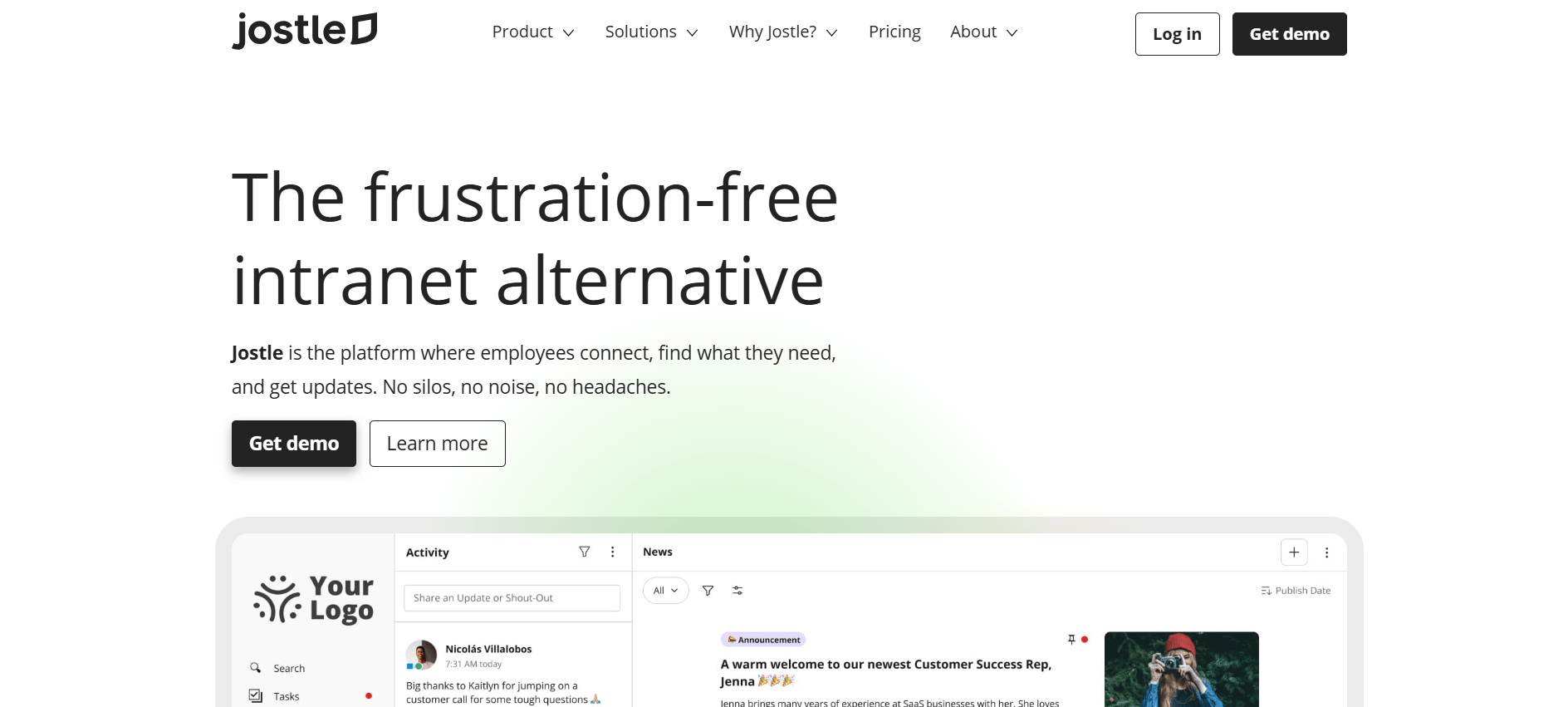
What it is: A straightforward intranet and employee communication platform focused on culture, connection, and ease of use. News, events, shout-outs, org charts, document libraries — all in a clean interface you can set up without IT help. Customers include ASOS, University of Illinois, and Citizens Bank.
Best for: Small to mid-sized organizations (including remote and hybrid teams) that want an affordable, easy intranet without the complexity of enterprise platforms.
Key features:
- Company news and announcements (targeted by team, division, or location)
- Employee recognition (Shout-Outs)
- Org chart and employee directory
- Events calendar
- Discussion forums
- Document library
- JostleTV (broadcast to break rooms or factory floors)
- Mobile app (iOS and Android)
- API and SSO integrations
- Built-in AI features
Limitations:
- Knowledge management is basic — no deep AI search or workflow integrations
- Fewer analytics and targeting tools than competitors
- SSO integration has been a consistent pain point in reviews
- Adoption falls flat without leadership push
- Doesn't scale well for large enterprises with complex governance needs
Pricing: Four tiers, per-user per-month (annual billing):
- Bronze: $2.77/user/month — core News, Activity, People, Discussions
- Silver: $4.98/user/month — adds Library, Links, HTML pages, and one optional module
- Gold: $6.64/user/month — includes three optional modules
- Platinum: custom quote — all optional modules
All plans include mobile apps, onboarding, SSO, Microsoft 365 and Google Workspace integrations, and AI features.
Conclusion
MangoApps has established itself as a strong solution for intranet and employee communication, but it’s not the only option. From mobile-first platforms like EngagedlyFX and Beekeeper.io to engagement-driven tools like Workvivo and Culture Amp, organizations in 2026 have a wide range of alternatives to choose from.
By evaluating features, user experience, and unique selling points, companies can select the platform that best fits their workforce—whether they’re focused on frontline communication, enterprise-wide personalization, or data-driven engagement. The right choice will not only improve internal communication but also strengthen company culture, engagement, and productivity.











Recent articles
.png)
.png)
.png)


Operate. Connect. Perform.
EngagedlyFX delivers actionable insights and engagement tools to reduce turnover, increase productivity and improve employee well-being.